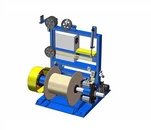
Wire
Wire armoring machines are used when cables need to withstand extreme conditions. These machines work by winding a single metal wire around the cable to form a strong yet flexible armored jacket. This produces a highly resilient cable that can withstand high pressures, tensile loads, and corrosive conditions.
The wire used in this armoring process is typically made of high-strength materials such as steel or galvanized iron, which provide excellent mechanical strength to the cable. Due to its rugged nature, wire armored cables are often used in industries such as oil and gas, mining, and marine applications where cables need to withstand high stress environments.
Not only does the armoring wire enhance the mechanical strength of the cable, it also provides an additional grounding path, improving the overall electrical safety of the cable. This grounding feature is particularly important in applications where electrical faults could pose a significant safety risk.
Strip
Strip armoring machines are primarily used to produce armored cables and flexible conduits. The function of these machines is to continuously wind a metal strip, typically made of galvanized steel or aluminum, around the cable, conduit, or optical fiber. The metal strip is typically wound around the core in a spiral pattern to form a strong interlocking armor that provides excellent mechanical protection. Tape Armoring Machines play an important role in enhancing the mechanical strength of cables and flexible conduits.
This armoring layer provides a high degree of mechanical protection without significantly increasing the overall diameter of the cable or conduit, making it suitable for applications that require durability and resistance to environmental factors.
Armoring tapes are frequently used in the production of power cables, communication cables, and flexible conduits for use in various fields such as construction, telecommunications, and the oil and gas industry.
Interlocking
Interlocking Armoring Machines are designed to produce a unique form of cable or conduit protection called interlocking armor. This process involves creating a flexible, interlocking metal sheath around the core of a cable or conduit.
Interlocking Armoring Machines specialize in producing unique interlocking armor sheaths that have excellent flexibility and bendability. In commercial and industrial buildings, interlocking armored cables are often used for wires that need to go around corners or through tight spaces. These cables can withstand large bends and twists without damaging the inner conductors.
Interlocking armor is distinguished from other armoring technologies by its unique structure and high flexibility. Armoring machines wrap flat metal strips, such as aluminum and steel, around the cable in an overlapping, interlocking pattern to form a continuous metal tube. This interlocking pattern gives the armor flexibility, allowing it to bend with minimal stress on the cable or conduit inside, while still providing strong mechanical protection.
In addition, interlocking armor has excellent compressive and tensile strength, making it suitable for a variety of environments. For example, in the oil and gas industry, interlocking armored flexible pipe is used to transport high-pressure fluids in harsh conditions. This armoring helps ensure the integrity and service life of the pipeline, even under mechanical stress.
Basket Weave
The basket weave armoring process uses specialized machines to create a complex basket weave wire pattern to form a braided outer armor wrapped around the cable. The basic principle of this armoring is to cover the cable core with multiple layers of fine and flexible wires in a specific interlaced pattern. This special configuration resembles the structure of a woven basket, hence the name "basket weave" armoring.
Basket weave armoring machines effectively interweave individual wires together and wrap them around the cable core in a cross pattern. This method of wrapping the wires in alternating directions allows the armor to evenly distribute mechanical stress, thereby enhancing the overall tensile and compressive strength of the cable.
This armor provides mechanical protection. The braid pattern is highly flexible, allowing the cable to bend without damaging the internal components. At the same time, the braided structure gives the cable the ability to resist external pressure, making it suitable for applications where the cable may be subjected to high mechanical stress.
One application for basket braid armor is in the production of submarine cables. These cables must withstand the pressure of seawater, as well as damage that can be caused by marine life or underwater geological activity.
Kevlar
Kevlar armoring machines can be used to reinforce fiber optic cables and other wiring systems. Kevlar is a lightweight synthetic fiber with high tensile strength that provides durability and protection against physical damage. This armor is mainly used in applications where the cable needs to withstand high mechanical stress without reducing flexibility.
Kevlar armor is used to create rugged communications and data transmission cables, especially in environments where they may be subjected to stretching, bending or other forms of mechanical stress. The Kevlar jacket not only protects the internal optical fibers, but also increases the overall tensile strength of the cable, allowing it to withstand huge mechanical strains during installation and throughout its service life.